

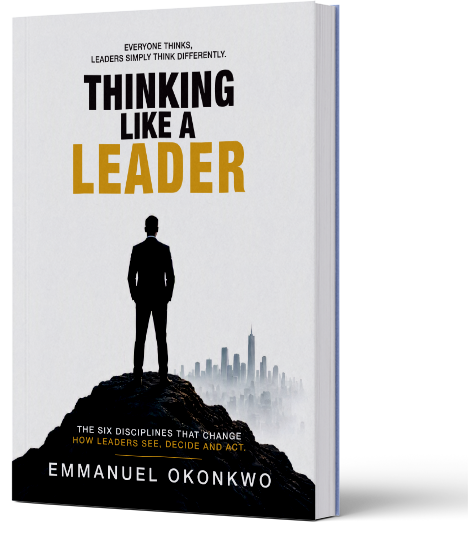
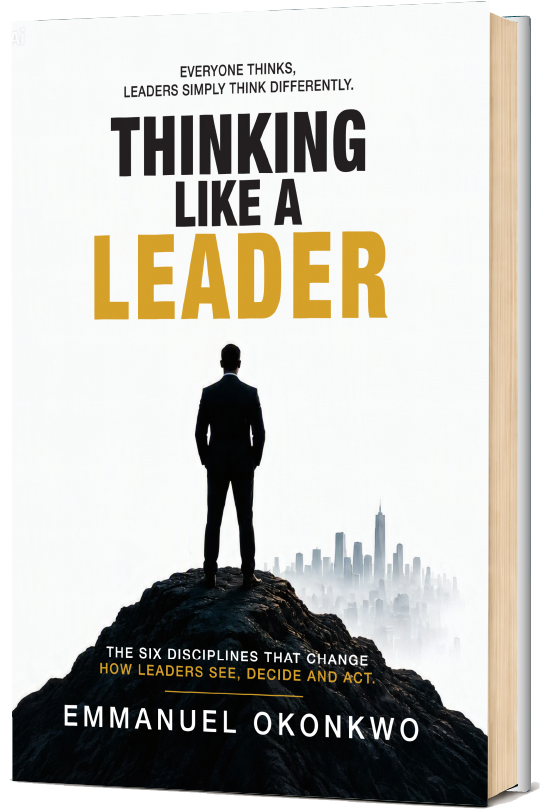
The Six Disciplines That Change How Leaders See, Decide and Act
Everyone thinks. Leaders simply think differently.
What if leadership development began not with behaviour, but with the thinking that produces behaviour?
Two people can face the same situation and see completely different things.
One sees a problem. Another sees an opportunity. One reacts to what is happening now. Another asks what today’s decision will produce tomorrow. One assumes they have the answer. Another asks, “What can others see that I cannot?”
That is why leadership development must go deeper than behaviour. We have to develop the thinking behind the behaviour.
Thinking Like a Leader introduces Leadership Thinking: six disciplines for developing the way leaders see, decide and act.
Learn to anticipate rather than merely react. Tomorrow usually whispers before it shouts.
Turn experience into insight by examining assumptions, decisions, outcomes and lessons.
Separate evidence from assumption and use reason to protect decisions from avoidable error.
Recognise that intelligence is distributed. Strong leaders deliberately invite perspectives they do not possess.
Make decisions with consequences, successors and the next generation in view.
See relationships, trade-offs, timing and consequences. Strategy is choice.
Leadership places people in situations where decisions carry consequences. The quality of those decisions is shaped by what leaders notice, what they assume, what they ignore, whose perspective they seek and how far into the future they are willing to think.
Thinking prepares the decision. Leadership accepts responsibility for what happens next.
The goal of this book is not to create leaders who merely sound thoughtful. It is to develop leaders whose thinking changes the quality of their action.
Experience is not the best teacher. Reflected-upon experience is.
Average people collect experiences. Leaders collect lessons.
Emotion may inspire decisions, but logic protects them.
Reason is the steering wheel. Emotion is the accelerator.
Leadership is temporary, but its consequences can be generational.
Strategy is choice.
The most valuable leader in this book is not one of the people we studied. It is the leader you can still become.
Everyone thinks. Leaders think differently — and then they act.
—
Kindly fill out the form below and I will get back to you